

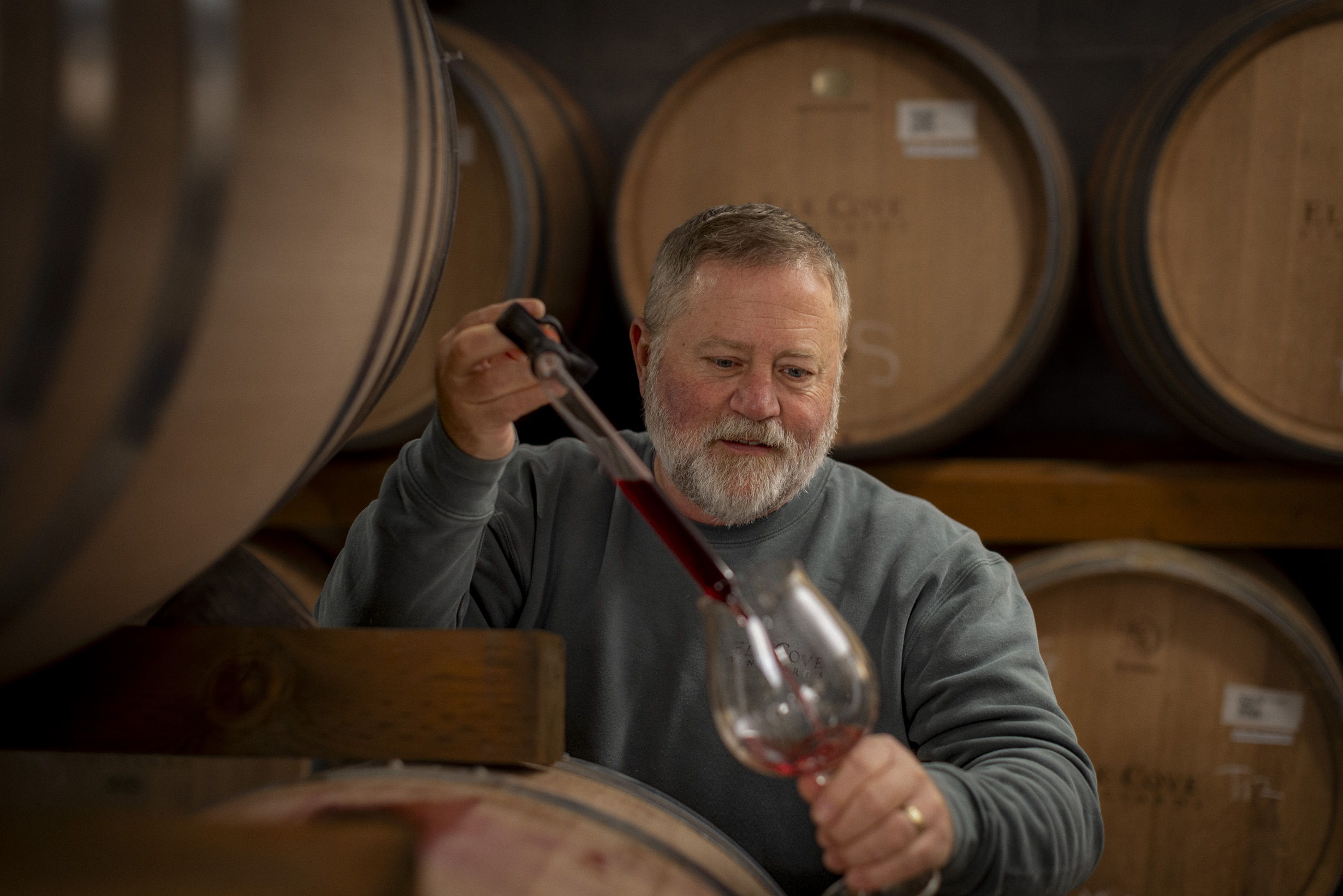
How are our 2025 Pinot noirs doing? It’s time to start tasting them…
In the video below, Owner/Winemaker Adam Campbell gives us an update on Vintage 2025 on January 28th, now that both primary and secondary fermentation is finished. We can finally get a read on the vintage for Pinot Noir now that the wines have softened and are starting the maturation process in barrel.
TRANSCRIPT:
ANNA (off camera) So what’s happening in the cellar this time of year?
ADAM: Traditionally, it’s a slower time of year. It gives us an opportunity to taste barrels and to see what’s working. I like the idea that the Pinot noirs and these barrels behind me, they’re just kind of settling, becoming a little more clarified, and we’re starting to get a real sense for how the French oak barrel is integrating into the fruit of the wine.
So we try to take the kind of winter, early spring months to do our assessments about how the vineyards worked for us last year, but also, uh, the choices for barrels and how they work with the wines. And we start thinking about what our blending opportunities will be come the summer months.
ANNA: So is fermentation finished?
ADAM:So the primary fermentation finished back in October in the stainless steel fermenters we have upstairs. And then they come to barrel and they go through what’s called a malolactic fermentation, which is where, uh, the malic acid in a wine converts to lactic acid. And all quality red wines go through this process. It’s a natural process that kind of softens the wine, integrates the flavors of the barrel into the wine, and it makes it more stable. Once they go through that malolactic fermentation is when we can start really getting a read on the qualities of the wine and where they might end up.
We call it malolactic fermentation because it’s converting malic acid, like what’s in apples to lactic acid, like what’s in milk. So both apples and milk are really acidic, but if you think about lactic acid that’s creamy and it’s kind of broad and and softer, and that’s how you get a wine that’s kind of broader and richer, really important for all red wines and for some specific white wines.
ANNA: So do you have any favorite barrels? Are they really that different?
ADAM: Yeah. So all the cooperage that we use is all French, mostly actually coopered in Burgundy in France, the motherland of Pinot noir. And we think of that as important because they have a real sensibility for how to work with Pinot noir and all the barrels. It’s a handmade process there, bent and toasted over a fire. And so the quality of the work becomes really important to the finished product of a wine.
We wish we could use American oak at times because it would be more local to us, but it’s just a very different flavor and I think for the delicacy and beauty of Pinot noir, it really needs these French oak, primarily Burgundian cooper barrels to give us that full expression of what is possible with Pinot noir.
ANNA: And do we have a favorite cooperage?
ADAM: Well, we buy from about 12 different coopers and we buy about 150 to 200 barrels per year. We buy from 12 different ones to hone in on what works with our wines and which cooperage is doing the best work. We definitely have some favorites.
Some of my favorites too, one called Taransaud cooperage and another one called Boutes… We see consistency of quality, they’re often elevated into our single vineyard program. So, I’d be lying if I didn’t say I had a few favorites. Mm.
ANNA: So why don’t we just get barrels from those two cooperages?
ADAM: We’ve seen over the years that that qualities of the barrel kind of, you know, changes a little bit over time. And I think we buy from 12 different coopers (because) it’s part of that exploration process of trying to find and, and not being dogmatic about what works with our wines. We wanna keep exploring and if there’s another cooperage that does good work, we might buy five or 10 barrels from them. If it doesn’t make the cut the next year, we’d find another cooperage to start working with.
ANNA: So… I know these barrels are all coming from France. How do we get them here?
ADAM: So you have to order ’em about six months in advance. They come over by ship and they come over empty and assembled and built. So it’s quite a process to get them here. It’s very expensive. French oak is sought around the world for wine production and also for Cognac and other things. So… we have to compete with everybody to get the best quality barrels and, you know, if we’re making decisions six months in advance, that’s kind of what we need to do to access those best barrels.
ANNA: Yeah. So is it worth it? Like why not why not just make wine without barrels if they’re so expensive and they take so long to get here and it’s so competitive?
ADAM: It’s so important. You know, if you think about pinot noir, it’s not just the oak flavor that it imparts, the French oak flavor, that’s a bit of it, but it’s also about kind of opening the wine up. So each of these barrels the staves essentially kind of breathe and you get very slow oxygenation of the wine through the staves of the barrel. And uh, that’s how wine (goes) from a really primary and kind of tight knit wine coming out of a fermentor into more developed full bodied wine that you’d have on your dinner table.
ANNA: Mm-hmm. Cool. So you’re starting to taste the next vintage… What do you think?
ADAM: Yeah, really excited about 2025… We picked over about a five week period, so there’s a lot of variation and I kind of like that because it means that what we can do is we can taste each barrel not only to see what works for 2025 single vineyard wines or for our Willamette Valley blend, but also to really kind of check our work and how we did for future vintages. We did some experiments, we did some whole cluster, different types of fermentations, and we’ll be able to make these assessments. It’s in that continual improvement process that we always wanna be doing.
ANNA: Very cool. Well, I can’t wait to try them once they’re in bottle.
ADAM: Yeah, sounds great. Thank You. Cheers!


